
Anchorage
Anchorage (/ˈ æ ŋ. k. ɹ ɪ ʒ /; in dena'ina: Dgheyay Kaq), officially a municipality of Anchorage, is a city and borough in southern Alaska, USA. In 2017, its population was estimated at 294,356 and 401,499 for the metropolitan area, making it the most populous city in Alaska. It comprises a significant proportion of the population of its State (40%). It is the second city in the United States (after New York) to concentrate such a population relative to the state in which it is located. The city was named four times All-America City (en) , in 1956, 1965, 1984/1985 and 2002 by the National Civic League. On the fiscal side, Kipplinger has also named it the best city in the United States.

| Official Name | (en) Anchorage |
|---|---|
| Local Name | (en) Dgheyay Kaq' |
| Nickname | The City of Lights and Flowers |
| Country |  United States United States |
|---|---|
| State | Alaska |
| Borough | municipality of Anchorage (d) |
| Part of | Central Alaska of the South (en ), organized boroughs of Alaska (d) |
| Capital | - |
| Capital of | Alaska |
| Area | 4,420 km2 |
| Water surface | 13.07% |
| Altitude | 31 mths |
| Coordinates | 61° 13′ 06″ N, 149° 53′ 57″ W |
| Population | 294,356 hab. () |
|---|---|
| Number of households | 113,032 () |
| Density | 66.6 hab./km2 () |
| Status | City in the United States, big city (d), city-county grouping |
|---|---|
| Chief Executive Officer | Ethan Berkowitz (en) |
| Twinning | Chitose, Darwin, Incheon, Magadan, Tromsø, Whitby, Harbin, Khabarovsk |
| Foundation |
|---|
| Currency | Big Wild Life |
|---|
| Postal Code | 99501-99524, 99530 |
|---|---|
| FIPS Code | 02-03000 |
| GNIS | 1398242 |
| TGN | 7013298 |
| Telephone code | 907 |
| Website | (en) www.muni.org |
Etymology
The original full name is Knik Anchorage, which means "Knik anchorage" (Knik was the former Inuit village that was there and whose name means "fire").
In 1914, when Anchorage was founded, it was only a port, a anchorage for the construction of the Alaska Railroad railway.
History
Russian presence on the territory
The Russians settled in southern Alaska in the early nineteenth century. In 1867, US Secretary of State William Henry Seward negotiated the purchase of Alaska because imperial Russia had a debt of $7.2 million (less than two cents per acre or $4.20 per square kilometer). The operation was criticized by politicians and called "Seward's madness", "Seward's glacier" or "Walrussia". In 1888, gold was discovered along the Turnagain Arm, at the bottom of the Cook Gulf. In 1912, Alaska joined the United States as a territory.
In 1914, President Woodrow Wilson authorized the construction of the Alaska Railroad and the establishment of the Chamber of Commerce and Industry. A tent village was then established at Ship Creek Landing near the mouth of the Ship Creek River and the site of the future railway station, since this modest port was chosen as the departure base and seat of the railway line. Very quickly, the population reaches 2,000. As of , the first town houses are sold. Anchorage first knows several different names but the U.S. Post Office decides to formalize the current name. Initially, the city was placed under the administration of the federal government, but local citizens lobbied the federal government to transfer power to a municipality that was finally established on .
During the First World War, the Anchorage population and industry collapsed. However, the completion of the construction of the Alaska Railroad in 1923 reinforces the city's economic expansion during the 1920s.
Between Wars and Growth: 1930-1964
Between 1930 and 1950, air transport became increasingly important. In 1930, the airport changed its name to Merril Field. During the 1930s, the airport became one of the busiest in the United States. On , Anchorage International Airport opened and operated transpolar air traffic between Europe and Asia.
From the 1940s, the American military presence in Alaska was strengthened. The Americans built the bases of Fort Richardson and Elmendorf Air Force Base. Much military investment occurred during the Second World War, as a result of the Japanese invasion, and continued later in 1950, because of the Cold War.
In the 1940s and 1950s, Anchorage developed and began to become a city. It increased from 3,000 inhabitants in 1940 to 47,000 in 1951. Crime and the cost of living also increased during this period. In 1949, the first traffic light was installed on Fourth Avenue. In 1951, the Seward motorway was opened to traffic. KTVA, the city's first television station, began broadcasting in 1953. In 1954, the Alyeska Resort opened.
On , Alaska became the 49th State of the United States. Some time later, Anchorage faced a real estate crisis, which would be stopped by the expansion of the Anchorage agglomeration. In , Anchorage became a city and a borough.
Anchorage tried, in vain, to host the Winter Olympics in 1992 and for the last time in 1994.
1964 earthquake
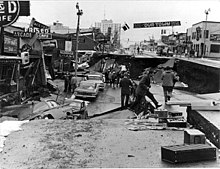
The city experienced an earthquake of magnitude 9.2 on , the largest in North America. The earthquake lasted only a few minutes but destroyed many of the city's buildings. Since then, the height of the buildings has been limited to 21 floors. There were large landslides, and tsunamis ravaged the surrounding fjords. This disaster, called Good Friday Earthquake because it happened on Good Friday, claimed the lives of 115 people. The damage amounted to 300 million US dollars and reconstruction was the main objective of the 1960s. This is the second largest earthquake in history after the earthquake in Chile.
Reconstruction and discovery of oil: 1965-1999
In 1968, oil was discovered at Prudhoe Bay on the north coast of Alaska, a barrel was sold for the state in 1969 for millions of dollars. In 1974 the construction of the Trans-Alaska Pipeline began and was completed in 1977 at a total cost of US$8 billion. The discovery of oil and the construction of the pipeline give a new aspect to the region and Anchorage becomes the seat of oil companies. Anchorage Ted-Stevens International Airport is booming economically and Anchorage is becoming an air hub in the world due to its geographic location. Today, it is the world's fourth-largest freight airport, which stood at 2.07 million tons in 2003.
In 1975, the city and the borough united. In this unification, it includes Eagle River, Eklutna, Girdwood, Glen Alps and several other communities. The new area is called Municipalité d'Anchorage. In 1980, the population of Anchorage increased to 184,775 inhabitants.
In the early 1980's, Anchorage experienced a period of growth due to the influx of oil production. The city's beautification projects, combined with community planning, enable the construction of infrastructure and increase the quality of life. These projects led to the construction of a new library, a civic center, a sports room, a show room, a ski resort and the Kincaid Outdoor Center. However, in the late 1980s, oil prices fell and led to Anchorage's recession.
After growth based on oil alone, Alaska went through an economic depression in the 1990's. In Anchorage, all consumer products and services were more expensive than in New York. The recession led to a fall in the housing market. Apartments offered at 40% of their price could not find a buyer.
In 1996, Anchorage hosted the Arctic Winter Games in Chugiak and Eagle River, and in 1999, the Alaska Native Center opened.
twenty-first century
On , the airport is renamed the Anchorage Ted-Stevens International Airport (Ted Stevens Anchorage International Airport) in honor of the oldest Alaskan senator, Ted Stevens. Although the development of the city must now turn to the urbanization of the entire area of the Anchorage bowl (local nickname for the region of Anchorage), there are still many sparsely populated areas and vast areas dedicated to parks and green spaces.
Geography
Situation
Anchorage is located southeast of the Alaska Peninsula and Kodiak Island just north of the Kenai Peninsula, northwest of Prince William Bay, and southeastern Alaska and south of Denali. It is also at 61 degrees north, roughly at the same level as Stockholm, Oslo, Helsinki, and St. Petersburg, but not as northern as Reykjavik and Murmansk. The town is located on a coastal plain and extends to the slopes of the Chugach Mountains. The town is built on a triangular peninsula, at the bottom of the Cook Inlet (in the Cook Gulf) bordered by two sea arms, the Turnagain arm and the Knik arm, and to the east by the Chugach Mountains that encompass part of the Chugach National Park.
Topography
The coastline is made up of mudflats. Tourists are warned not to walk in these places because of the large variations in tides and silt glaciers, and some reckless walked on the vase that had a solid appearance and were swallowed by quicksand in 1961 and 1988.
Despite the limited space of the peninsula on which Anchorage is built, the city has managed to preserve many green spaces, which makes it attractive to those who love nature.
Cultural life is also very active, especially from a musical point of view. There is a symphonic orchestra, an opera company as well as traditional Irish music. There are two main museums: the Anchorage Museum of History and Art and the Alaska Native Heritage Center.
Environment
Fauna
The town of Anchorage is a wild life area; urbanization is increasingly encroaching on nature, forcing wildlife to live near homes. Experts estimate that there are approximately 250 black bears and 60 grizzly bears in and around the urban area. It is not uncommon to see bears or moose, whose population can vary between 250 and 1,000, depending on the season. They pose a danger to drivers, about 100 moose are killed each year in traffic accidents. The population is well prepared for this kind of meeting, there are very few accidents and casualties on the human side, only two people have died trampled by this animal in recent years. The Alaska Departement of Fish and Game kills a few aggressive moose every year in the city. Dall's sheep can be seen frequently along the route between Anchorage and Seward Girdwood. Finally, there is also an estimated wolf population of 30 individuals. In 2007, several dogs were killed by wolves while walking with their owners. This proximity is not without consequences: it is not advisable to leave the garbage and even less food near the houses so as not to attract bears. It is quite common to find beaver dams in streams or to see foxes near wooded areas in spring. Along the Seward motorway, heading towards Kenai, it is not uncommon to see whales in the Turnagain Arm.
Climate
Anchorage has a subarctic climate, similar to a cold Mediterranean continental climate with a dry summer (Dfc according to the Köppen classification), but also strong maritime influences that give moderate temperatures. Average temperatures in summer vary from 13 to 26 °C. Average winter temperatures vary from -15 to 1.1 °C. Anchorage may not have frost for more than 100 days.
The average temperatures in January at Anchorage Airport (PANC) are -13 to 6 °C with an average snow of 1800 mm. The snow records date from the winter of 1954-1955 with 3 373 mm of snow. The lowest temperature was recorded at Merrill Field on and was -38.9 °C.
Summer temperatures are fairly mild (compared to the contiguous United States and within Alaska), it can rain frequently. Average temperatures in July range from 11 to 19 °C. The highest temperature was recorded on at 32.2 °C. The annual average precipitation is 406 mm. The latitude of Anchorage causes very long summer days and very short winter days. The city's skies are often cloudy in winter, which reduces sunlight.
Due to its proximity to active volcanoes, the risks of ash are important, although very rare. The most recent volcanic activity centered around the multiple eruptions of Mount Redoubt in March-, causing an ash cloud of 7,600 m and an accumulation of these ash in the Cook Inlet region. Previously, the most active event in recent years was an eruption of Mount Spurr in , located 126 km west of the city. This eruption placed 3 mm of ash on the city. Cleaning the ash took a lot of water and had a lot of problems with the city's sewage.
The month of is the hottest and driest one Anchorage has ever seen.
Below is the weather report for the city of Anchorage:
| Month | jan. | Feb. | March | April | May | June | Jul | August | sep. | oct. | Nov | Dec. | year |
|---|---|---|---|---|---|---|---|---|---|---|---|---|---|
| Average minimum temperature (°C) | -13.1 | -11.4 | -7.7 | -1.9 | 3.8 | 8.4 | 10.9 | 9.7 | 5.3 | -1.8 | -9.4 | -12.2 | -1.6 |
| Average Temperature (°C) | -9.5 | -7.4 | -3.5 | 2.1 | 8.1 | 12.4 | 14.7 | 13.5 | 9.1 | 1.4 | -6 | -8.7 | 2.1 |
| Average Maximum Temperature (°C) | -5.9 | -3.4 | 0.6 | 6 | 12.4 | 16.4 | 18.4 | 17.2 | 12.9 | 4.7 | -2.7 | -5.3 | 5.9 |
| Cold record (°C) record date | -37 1975 | -39 1999 | -31 1971 | -26 1985 | -17 1964 | -2 1961 | 1 1964 | -1 1984 | -7 1992 | -21 1956 | -29 1956 | -38 1964 | -39 1999 |
| Heat record (°C) record date | 13 1961 | 14 1991 | 13 1984 | 22 1976 | 28 1969 | 33 1969 | 32 2019 | 29 1978 | 23 1957 | 18 1993 | 17 1979 | 12 1999 | 33 1969 |
| Precipitation (mm) | 20.1 | 19.8 | 17.5 | 17 | 18.5 | 29 | 43.4 | 62 | 68.6 | 51.6 | 28.2 | 28.4 | 404 |
| Rain record in 24 h (mm) record date | 21 1961 | 29 1956 | 32 1986 | 20 1989 | 25 1980 | 41 1962 | 51 1956 | 70 1997 | 34 1982 | 43 1952 | 29 1964 | 35 1955 | 70 1997 |
| Snow record in 24 h (cm) record date | 198 1987 | 330 1996 | 363 1976 | 203 1977 | 23 1985 | 0 | 0 | 0 | 76 1992 | 213 1982 | 234 1996 | 353 1998 | 363 1976 |
| Number of days with precipitation | 8.1 | 7.2 | 6.8 | 5.5 | 7 | 8.2 | 11.3 | 13.8 | 14.5 | 12.3 | 9.3 | 11.1 | 115.1 |
| of which number of days with precipitation ≥ 5 mm | 0.1 | 0.1 | 0.1 | 0.1 | 0.1 | 0.4 | 0.7 | 1.4 | 1.4 | 1.1 | 0.3 | 0.2 | 6 |
| Relative humidity (%) | 59.5 | 73.5 | 68.5 | 61.5 | 58 | 58 | 64 | 70 | 72 | 71 | 72 | 75.5 | 74.5 |
| Number of days with snow | 7 | 5.9 | 5.8 | 3.4 | 0.2 | 0 | 0 | 0 | 0.2 | 4.3 | 7 | 8.8 | 42.6 |
Demographics
| Census History | |||
|---|---|---|---|
| Ann. | Pop. | % ± | |
| 1920 | 1,856 | — | |
| 1930 | 2,277 | ▲ +22.68% | |
| 1940 | 3,495 | ▲ +53.49% | |
| 1950 | 11,254 | ▲ +222% | |
| 1960 | 44,237 | ▲ +293.08% | |
| 1970 | 48,081 | ▲ +8.69% | |
| 1980 | 174,431 | ▲ +262.79% | |
| 1990 | 226,338 | ▲ +29.76% | |
| 2000 | 260,283 | ▲ +15% | |
| 2010 | 291,826 | ▲ +12.12% | |
| Is. 2018 | 291,538 | ▼ -0.1% | |
| United States Census Bureau | |||
| Group | Anchorage |  Alaska Alaska | United States |
|---|---|---|---|
| White | 66.0 | 66.7 | 72.4 |
| Alaska Native People | 7.9 | 14.8 | 0.9 |
| Métis | 8.1 | 7.3 | 2.9 |
| Asian | 8.1 | 5.4 | 4.8 |
| African-Americans | 5.6 | 3.3 | 12.6 |
| Others | 2.4 | 1.6 | 6.2 |
| Oceanians | 2.0 | 1.1 | 0.2 |
| Total | 100 | 100 | 100 |
| Hispanics and Latin Americans | 7.6 | 5.5 | 16.7 |
According to the American Community Survey, for the period 2011-2015, 82.30% of the population over 5 years of age reported that they spoke English at home, while 5.02% reported that they spoke Spanish, 3.10% said they spoke Tagalog, 1.36% said they spoke an indigenous language, 1.26% said they spoke Hmonkey language g, 1.09% Korean and 5.86% another language.
Economy
The economy grew around public and military activities (there are two important bases nearby), oil and tourism in summer.
Transport
- Air transport
Anchorage Ted-Stevens International Airport is the fourth largest international airport in terms of merchant traffic after Memphis, Hong Kong and Tokyo. It is also a hub for Alaska Airlines.
- Maritime transport
The port of Anchorage is the first port in Alaska in terms of volume, as 95% of all goods (excluding oil) that pass through it from or to the state.
- Rail transport
The city remains the hub of the Alaska Railway with the Alaska Railroad.
- Urban transport
Anchorage is served by the 14 bus lines of the public company People Mover.
Policy and Administration
The city's administration is a municipal-run government. The council includes the mayor and eleven members, elected by universal suffrage for three years. A municipal manager manages all services.
Education
Public education in Anchorage, Eagle River, Fort Richardson, and Elmendorf Air Force Base, is run by the school district of Anchorage, the eighty-seventh largest district in the United States, with nearly 50,000 students attending 88 schools. There are also a number of private schools, whether religious or not. Anchorage has four higher education institutions of university or master's degree: University of Anchorage, Alaska Pacific University, Charter College, and the Anchorage campus, based on Wayland Baptist University in Texas. Other continuing education institutions exist in Anchorage, including the Grainger Leadership Institute, nine Star, CLE International, Nana Worksafe and DBA PackBear Barr & Co.
90% of adults in Anchorage have a high school diploma (equivalent to LAC), 65% have completed a three-year university degree, and 17% have a higher degree.
Sport
- Anchorage's Northern Knights: minor league basketball team between 1977 and 1982.
- The Alaska Islands: an ice hockey team that played in the WCHL between 1990 and 2003, and ECHL 2003 to the present.
Cults
- Roman Catholic Archdiocese of Anchorage-Juneau
- Cathedral of the Holy Family of Anchorage
- Mormon Temple of Anchorage
People from Anchorage
Photogallery
View of the metropolitan area of Anchorage from the Chugach Mountains.
Anchorage, Alaska.
Sunrise over the Captain Cook Hotel.
Notes and References
References
- Pronunciation in American English transcribed phonemically according to the API standard.
- (en)"U.S. Census Bureau QuickFacts: Anchorage municipality, Alaska; UNITED STATES", on census.gov (accessed April 17, 2018).
- (en) "Annual Estimates of the Resident Population: April 1, 2010 to July 1, 2017", on factfinder.census.gov (accessed April 17, 2018).
- (en) "All-America City Award Winners", National Civic League (accessed April 2, 2010).
- (en) "Top 10 Tax-Friendly Cities", Kipplinger (accessed April 2, 2010).
- "anchorage" and "port" extension
- Louis Deroy and Marianne Mulon, Dictionary of Place Names, Le Robert, (ISBN 285036195X )..
- (en) "A Brief History of Alaska Statehood", xroads.virginia.edu (accessed April 2, 2010).
- (en) "History of Anchorage", on the site of the municipality of Anchorage (accessed April 2, 2010).
- (en) "History of Anchorage International Airport", on the airport's site (accessed April 3, 2010).
- (en) "Elmendorf Air Base History", military base site (accessed 3 April 2010).
- (en) "Seward History", on the official site of the city of Seward (accessed April 3, 2010).
- (en) "Events of 11 December 1953", on brainyhistory (accessed 3 April 2010).
- (en) "About Alyeska", on the ski resort site (accessed April 3, 2010).
- (en) Cherie Northon, A Cultural and Historical Geography of Campbell Creek, Anchorage, Alaska (read online), p. 17..
- (en) "History of Anchorage", on usacitiesonoline (accessed April 3, 2010).
- (en) "Results of the votes of the Olympic Committee", on aldaver (accessed 3 April 2010).
- (en)"The Alaskan Earthquake"[archive of November 2, 2009], earthquake.usgs.com(accessed April 3, 2010).
- (en)"The most destructive earthquakes since 1900" [archive of November 7, 2010], earthquake.usgs.com(accessed April 3, 2010).
- Alyeska 2013, p. 12.
- André Gamblin, World Economic Images 2005, Armand Colin (ISBN 2-200-26765-7 ), p. 373..
- (en) Larry Kaniut, Danger Stalks the Land: Alaskan Tales of Death and Survival, St. Martins Press, (ISBN 0-312-24120-8 ), p. 2-6 and 287-291..
- (en)"Bears among us: Too close for comfort?", on adn.com (accessed April 2, 2010).
- (en) James Halpin, "North-Side Wolf Pack Attacks, Kills Dogs North of Anchorage", on wolfsongnews.org, (accessed April 6, 2010).
- (en)"Living with Wildlife in Anchorage: A Cooperative Planning Effort", Alaska Dept. of Fish and Game (accessed April 6, 2010).
- "Weather and climate: Alaska (USA) - When to go to Alaska?", on a-contresens.net.
- "Record Heat in Alaska: temperatures exceed 30 degrees", on BFMTV, .
- (en) "Possible percentage of solar brightness" [archive of 17 June 2008], on Noaa (accessed 6 April 2010).
- (en) "The eruption of Mount Spurr in 1992", Alaska Volcano Observatory (accessed April 6, 2010).
- (en) World Climate, "Anchorage, AK, Alaska, USA:Climate, Global Warming, and Daylight Charts and Data", on Climate-charts (accessed 2 April 2010).
- (en) "Anchorage Climate Survey", on Climate-zone.com (accessed 6 April 2010).
- (en) "Anchorage Climate Survey", on Noaa (accessed April 6, 2010).
- (en) "Anchorage Climate Survey", on weather.com (accessed April 6, 2010).
- (en) "Historical Census Statistics On Population Totals By Race, 1790 to 1990, and By Hispanic Origin, 1970 to 1990, For Large Cities And Other Urban Places In The United States (Alaska)", on the United States Census (accessed April 7) 2010).
- (en) Riley Moffatt, Population History of Western U.S. Cities & Towns, 1850-1990, Lanham, Maryland, Scarecrow, (ISBN 0-810-83033-7)..
- (en) "Anchorage, AK Population - Census 2010 and 2000", on censusviewer.com.
- "Population of Alaska - Census 2010 and 2000", censusviewer.com.
- (en) "Language spoken at home by ability to speak français for the population 5 years and over", on factfinder.census.gov.
